Bianca Censori: The Complete Fashion Analysis
A Comprehensive Exploration of Grammys 2025, Signature Outfits, and the Cultural Phenomenon Surrounding Fashion’s Most Discussed Muse
Introduction: The Bianca Censori Phenomenon
In the annals of contemporary fashion history, few figures have generated as much discourse, controversy, and fascination as Bianca Censori. The Australian architect-turned-style-icon has, in a remarkably short span, redefined the parameters of celebrity fashion, red carpet expectations, and personal expression through sartorial choices. This comprehensive analysis delves beyond the sensational headlines to examine the intricate tapestry of influences, intentions, and impacts that constitute what we now recognize as the “Bianca Censori phenomenon.” From her early days as an architectural designer to her current status as one of fashion’s most photographed and analyzed figures, Censori’s journey represents a compelling case study in modern celebrity, creative partnership, and boundary-pushing aesthetics.
What distinguishes Censori from other celebrity muses is not merely the provocative nature of her outfits, but the intellectual framework that underpins them. Trained in architecture at the University of Melbourne, she brings a structuralist perspective to fashion, treating each ensemble as a three-dimensional composition of form, space, and materiality. This architectural foundation, combined with her partnership with Kanye West—one of contemporary culture’s most influential creative forces—has produced a fashion narrative that transcends mere clothing to become a commentary on celebrity, autonomy, and the evolving relationship between body and fabric in the 21st century.


bianca censori grammys: The Definitive Analysis
The phrase “bianca censori grammys” represents more than a simple search query; it encapsulates a cultural moment where fashion, celebrity, and controversy intersected on music’s grandest stage. Censori’s appearances at the Grammy Awards have consistently generated seismic reactions across media platforms, fashion circles, and public discourse. Each Grammys attendance has marked an evolution in her style narrative, beginning with more conventional (though still avant-garde) ensembles and culminating in the boundary-obliterating looks that have defined her recent appearances.
What makes Censori’s Grammys moments particularly noteworthy is their calculated disruption of established red carpet norms. Where traditional celebrity fashion at awards shows often adheres to unspoken rules of modesty, brand alignment, and seasonal trends, Censori’s approach rejects these conventions in favor of a more personal, architectural vision. Her Grammys outfits function as deliberate statements about bodily autonomy, creative expression, and the performative nature of celebrity itself. The media frenzy surrounding each appearance—characterized by polarized reactions ranging from condemnation to celebration—reveals much about contemporary attitudes toward femininity, fashion, and public display.
Beyond the immediate controversy, Censori’s Grammys presence has sparked substantive conversations about fashion as art versus fashion as provocation. Critics argue that her choices prioritize shock value over aesthetic merit, while supporters contend that she is expanding the vocabulary of red carpet fashion and challenging patriarchal expectations of women’s public presentation. This dichotomy reflects broader cultural debates about authenticity, agency, and the evolving role of celebrity in shaping fashion discourse.
The specific search term “bianca censori grammys 2025” directs us to what may represent the apex of Censori’s fashion narrative thus far. The 2025 Grammy Awards appearance was not merely another red carpet moment but a cultural event that transcended fashion commentary to become a subject of mainstream news coverage, social media analysis, and academic discussion. The ensemble she wore—a meticulously crafted composition of sheer fabrics, strategic negative space, and architectural structuring—immediately became one of the most photographed, debated, and replicated looks in recent memory.
What distinguished the 2025 appearance from previous Grammys moments was its complete synthesis of Censori’s architectural background with fashion’s most public platform. The outfit appeared to be a living extension of structuralist principles, with each element serving both aesthetic and functional purposes. The transparency of materials created a dialogue between visibility and concealment, while the geometric precision of cutouts and seams referenced modernist architectural principles. This was not simply a “revealing” outfit in the conventional sense, but a deliberate exploration of form, line, and spatial relationships as they interact with the human body.
The cultural impact of the 2025 Grammys look extended far beyond fashion commentary. It sparked debates about media ethics (regarding censorship and blurring), double standards in celebrity treatment, and the evolving boundaries of public decorum. The outfit became a Rorschach test of sorts, with interpretations varying widely based on the viewer’s perspective: some saw empowerment and bodily autonomy, others saw objectification and calculated provocation, and still others saw a sophisticated artistic statement about the nature of contemporary celebrity.
The Architectural Foundation
Censori’s training in architecture represents the foundational element of her fashion philosophy. Where traditional fashion designers approach clothing as surface decoration or silhouette manipulation, Censori’s architectural background informs a more structural approach. Each outfit is conceived as a three-dimensional composition that interacts with both the body it adorns and the space it occupies.
This architectural perspective manifests in several key ways: the emphasis on geometric precision in cutouts and seams, the treatment of fabric as a building material with specific properties and behaviors, and the conceptualization of the body as both mannequin and architectural site. Her Grammys 2025 outfit, in particular, demonstrated this approach through its careful balance of solid and void, its play with transparency and opacity as spatial qualities, and its integration of structural elements that functioned both aesthetically and as support systems.
Deconstructing the Grammys Ensemble: Element by Element
To describe Censori’s Grammys attire simply as a “dress” is to fundamentally misunderstand its conceptual framework. While technically a garment worn on the body, the piece defies conventional categorization, existing somewhere between haute couture, performance art, and architectural intervention. The construction revealed a sophisticated understanding of materials, with multiple layers of differing transparencies creating complex visual effects as she moved under the camera flashes.
The silhouette represented a deliberate departure from traditional red carpet gowns. Where classic eveningwear often emphasizes hourglass shaping or columnar simplicity, Censori’s Grammys dress explored asymmetrical geometries that created unexpected lines and angles against her body. The strategic placement of structural elements—seams that followed anatomical contours, cutouts that revealed specific areas while concealing others, and transparent panels that created illusions of depth and dimension—demonstrated a meticulous planning process that balanced aesthetic impact with structural integrity.
Material selection played a crucial role in the overall effect. The use of engineered fabrics with specific reflective and translucent properties created dynamic visual effects under different lighting conditions. On the red carpet, camera flashes transformed the outfit into a shimmering, almost ethereal presence, while in more subdued lighting, its architectural qualities became more pronounced. This chameleonic quality—changing appearance based on context and perspective—added conceptual depth to what might otherwise be dismissed as mere provocation.
Beyond the specific Grammys context, the broader search term “bianca dress” reveals public fascination with Censori’s everyday style evolution and its relationship to her more dramatic public appearances. Unlike many celebrities who maintain a sharp distinction between red carpet extravagance and casual streetwear, Censori’s personal style demonstrates a consistent aesthetic philosophy across contexts.
Her non-ceremonial outfits often feature the same architectural principles evident in her formalwear, albeit in more wearable iterations. Structured silhouettes, unexpected cutouts, and thoughtful fabric manipulation appear consistently, suggesting that her fashion choices represent not merely performance for public consumption but a genuine personal aesthetic. This consistency has contributed to her credibility within fashion circles, positioning her not as a celebrity merely wearing controversial outfits for attention, but as someone with a discernible and coherent style philosophy.
Analysis of her everyday style reveals several recurring elements: monochromatic color schemes that emphasize form over pattern, asymmetrical hemlines and necklines that create dynamic visual interest, and a preference for minimalist accessories that allow the clothing’s architectural qualities to remain the focal point. These choices reflect both her personal taste and her architectural training, creating a wardrobe that functions as an extension of her creative identity rather than merely following trends or designer affiliations.
The Media Frenzy: Uncensored, Unblurred, and Unedited
The search term “bianca censori grammys uncensored” speaks directly to one of the most contentious aspects of her public appearances: media treatment and the ethics of representation. Following her Grammys appearances, numerous media outlets made editorial decisions to digitally alter photographs, applying blurring effects to areas deemed too revealing for their audiences. This practice ignited debates about journalistic integrity, bodily autonomy, and the inconsistent application of censorship standards across different public figures.
The demand for uncensored imagery represents more than prurient interest; it reflects a desire to engage with Censori’s fashion choices on their own terms, without editorial mediation. Supporters argue that censorship fundamentally alters the artistic intent of the outfits, transforming considered sartorial statements into mere titillation by framing them as something that requires concealment. This perspective positions Censori as an artist whose work is being misrepresented by media outlets unwilling or unable to engage with it as serious fashion rather than mere provocation.
The censorship debate also raises questions about evolving standards of public decency and the gendered nature of media representation. Comparable male celebrity fashion choices rarely receive similar treatment, highlighting persistent double standards in how male and female bodies are perceived and presented in media. This aspect of the conversation has elevated Censori’s fashion beyond personal style to become a focal point in broader discussions about gender equality, media ethics, and cultural attitudes toward the human form.
Closely related to the “uncensored” search term, “bianca censori grammys unblurred” specifically addresses the visual alteration techniques employed by various media organizations. The technical process of digital blurring—applying Gaussian blur or pixelation to specific areas of an image—has become a common practice in mainstream media when dealing with revealing celebrity outfits. However, in Censori’s case, this practice has been applied with particular frequency and intensity, transforming her outfits into something quite different from their original appearance.
The prevalence of blurred images has created a secondary market for unaltered photographs, with certain fashion publications and online platforms emphasizing their presentation of “unblurred” content as a form of authentic journalism. This dynamic has interesting implications for media economics and audience engagement, with platforms that present the outfits in their original form often experiencing significantly higher traffic and engagement metrics than those that apply censorship.
Beyond the immediate visual differences, the blurring debate touches on deeper questions about authenticity in digital media. In an age of increasingly sophisticated image manipulation, the line between ethical editing and misrepresentation grows increasingly complex. Censori’s case represents a particularly visible example of this tension, with some arguing that blurring constitutes a form of visual dishonesty that fundamentally misrepresents the subject, while others maintain it as a necessary editorial judgment for maintaining community standards.
The search for “bianca censori grammys unedited pictures” extends beyond the censorship debate to encompass broader concerns about photographic authenticity in celebrity culture. In an industry where virtually every published image undergoes some degree of retouching—from color correction and blemish removal to more substantial alterations of body proportions—the desire for unedited photographs represents a longing for authenticity amidst highly mediated representations.
Censori’s case presents unique challenges for this authenticity discourse. On one hand, her outfits are so inherently dramatic that they might seem to require little additional enhancement. On the other, the controversial nature of the clothing might incentivize publications to employ additional editing to either amplify or mitigate their impact, depending on editorial stance. The resulting variability in how different outlets present the same outfits creates a fragmented media landscape where audiences must actively seek out multiple sources to form a complete understanding of her appearances.
This fragmentation has interesting cultural consequences. It encourages media literacy as audiences learn to identify editing techniques and compare representations across platforms. It also highlights the performative nature of contemporary celebrity, where the “real” appearance exists somewhere between the live event, the professionally captured images, the edited versions published across various media, and the social media discourse that surrounds all of these representations.
The Collaborative Dynamic
Any analysis of Bianca Censori’s fashion evolution must consider her relationship with Kanye West, one of contemporary culture’s most influential creative forces. Their partnership represents a fascinating case study in collaborative creativity, with West’s established aesthetic philosophy merging with Censori’s architectural background to produce something distinct from either individual’s prior work.
This creative symbiosis manifests in several ways: the minimalist color palettes that recall West’s Yeezy collections, the avant-garde silhouettes that push beyond conventional fashion boundaries, and the deliberate provocation that has characterized much of West’s public persona. Yet Censori brings her own distinctive elements—the architectural precision, the sophisticated material understanding, and a different relationship to the female form that reflects her own perspective and agency.
The resulting fashion statements resist simple attribution to either individual, instead representing a genuine collaborative vision. This complexity challenges traditional narratives about celebrity relationships, creative ownership, and influence, presenting instead a model of partnership where both individuals contribute meaningfully to a shared aesthetic project.
The Power Couple Dynamic: Kanye West and Bianca Censori
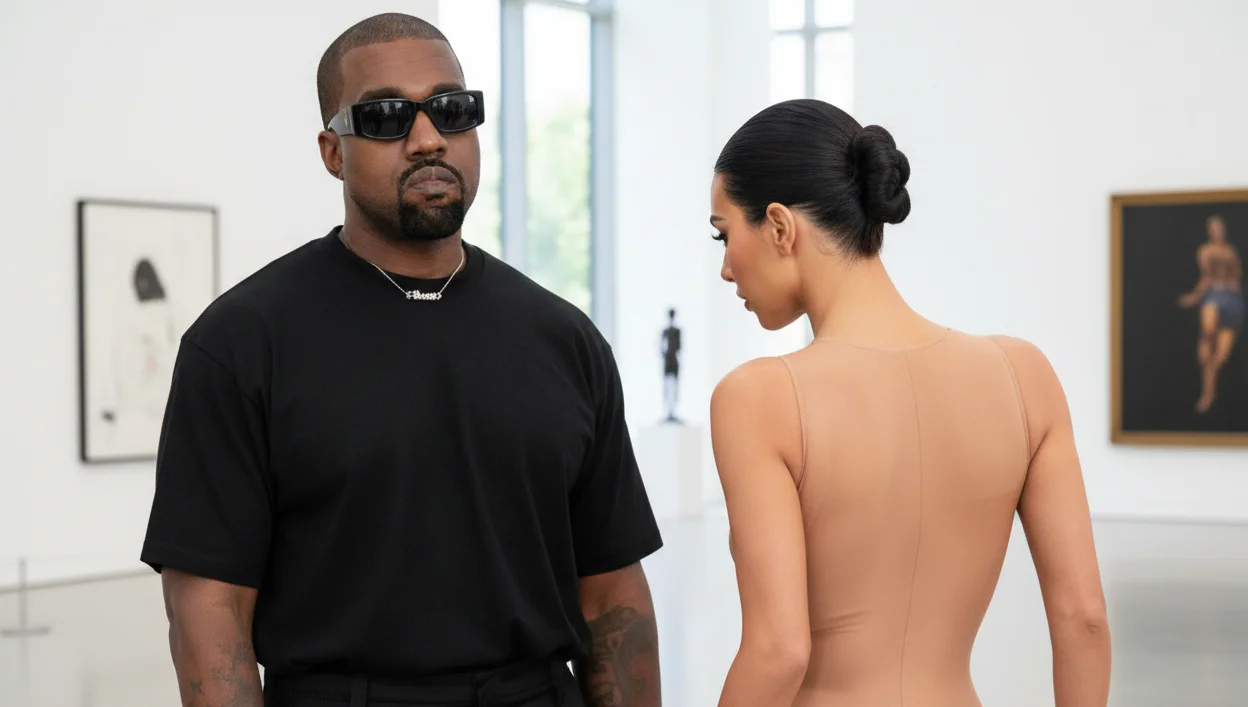
The specific search for “kanye west and bianca censori grammys 2025” reflects public fascination not just with Censori individually, but with her as part of one of contemporary culture’s most discussed creative partnerships. Their joint appearance at the 2025 Grammy Awards represented a carefully choreographed presentation of coupled identity, with both individuals’ outfits demonstrating complementary aesthetics while maintaining distinct personal statements.
West’s fashion choices for the event—typically minimalist, monochromatic, and architecturally influenced—created a visual harmony with Censori’s more dramatic ensemble without directly mirroring it. This approach demonstrated a sophisticated understanding of partnership presentation: neither matching in a traditional sense nor clashing for contrast, but existing in deliberate dialogue. Their physical interaction on the red carpet—the proximity, gestures, and shared moments—further reinforced this narrative of collaborative creativity and mutual support.
The media coverage of their joint appearance inevitably focused on their relationship dynamics as much as their individual fashion choices. This framing reflects enduring public fascination with celebrity couples as units of creative production and personal narrative. In West and Censori’s case, this fascination is amplified by both individuals’ established reputations as boundary-pushing creatives, making their partnership particularly rich terrain for analysis and speculation about influence, collaboration, and shared vision.
The specific phrasing “bianca censori grammys 2025 outfit not censored” indicates a desire to view the ensemble in its complete, unmediated form, free from editorial judgment or alteration. This search behavior reflects a growing consumer awareness of media manipulation practices and a corresponding desire for authentic representation, particularly when the subject matter involves controversial or boundary-pushing content.
Viewing the outfit without censorship allows for a more complete understanding of its design intent and aesthetic impact. The careful balance of transparency and coverage, the precise placement of each seam and cutout, and the overall silhouette become fully apparent only when the ensemble is viewed without digital alteration. This complete view reveals the outfit as a sophisticated exercise in architectural fashion rather than merely a provocative display, though it certainly functions as both simultaneously.
The technical aspects of the outfit become particularly evident in uncensored imagery: the engineering of support structures concealed within the design, the quality of materials and construction, and the relationship between the garment and Censori’s body as she moves and poses. These details, often obscured or distorted by blurring effects, are essential to understanding the outfit as a serious fashion statement rather than merely a controversial one.
Cultural Impact and Lasting Influence
The search term “bianca censori sexy pics,” while superficially straightforward, reveals complex cultural attitudes toward female celebrity, sexuality, and representation. Censori’s fashion choices intentionally engage with themes of sexuality and bodily display, making the collection and circulation of her images a particularly charged aspect of her public presence.
What distinguishes Censori’s case from conventional “sexy” celebrity imagery is the intellectual framework surrounding her presentation. Her background in architecture, her partnership with a major cultural figure, and her deliberate engagement with fashion as artistic practice complicate simple categorization of her images as merely titillating content. This complexity creates a tension between different modes of viewership: some approach her images as fashion documentation, others as artistic expression, and still others as conventional celebrity erotica.
This multiplicity of interpretations reflects broader shifts in how celebrity imagery circulates and is consumed in digital culture. The same photograph might appear on a high-fashion website analyzing its aesthetic qualities, a news outlet discussing its cultural impact, and a social media platform where it functions as conventional celebrity content. Censori’s awareness of this multi-contextual circulation likely informs her fashion choices, which seem designed to function meaningfully across these different frames of reception.
The phrase “bianca censori see through” addresses one of the most distinctive and controversial elements of her fashion vocabulary: the strategic use of transparent materials. This design choice represents far more than mere provocation; it engages with longstanding fashion traditions while pushing them in new directions.
Transparency in fashion has a complex history, from the diaphanous gowns of early Hollywood to the avant-garde experiments of 1960s designers like Rudi Gernreich and beyond. Censori’s use of sheer fabrics references this history while updating it for contemporary sensibilities and technological capabilities. Modern material engineering allows for transparency effects that would have been impossible with earlier fabrics, enabling more precise control over what is revealed and concealed.
The conceptual implications of transparency in Censori’s work are multifaceted. On one level, it engages with themes of authenticity and vulnerability in celebrity culture. On another, it plays with architectural concepts of solid and void, surface and depth. Additionally, it raises questions about the relationship between clothing and the body it adorns—whether garments should conceal the body entirely, reveal it completely, or exist somewhere in the nuanced space between these extremes.
The common misspelling “bianca sensori” reveals interesting aspects of search behavior and name recognition in digital culture. Despite being an incorrect spelling, this variation generates significant traffic, indicating both the breadth of interest in Censori and the casual nature of much online search behavior. This phenomenon is common with celebrity names, particularly those that are relatively new to public consciousness or have unusual spellings.
The persistence of this misspelling across platforms suggests several things about Censori’s public profile: that her recognition extends beyond fashion-interested audiences to more general celebrity followers, that her name recognition outpaces precise spelling knowledge for many, and that search algorithms have become sophisticated enough to recognize and correct common misspellings to direct users to relevant content.
This aspect of digital celebrity culture—where approximate knowledge leads to content discovery—represents an interesting evolution in how public figures enter and maintain public consciousness. It suggests that precise name recognition may be less important than overall cultural presence in the age of algorithmic search and social media recommendation systems.
Conclusion: Beyond the Controversy
The Bianca Censori phenomenon represents far more than a series of controversial outfits or attention-seeking celebrity behavior. It encompasses complex intersections of fashion, architecture, celebrity culture, media ethics, and gender politics. Her journey from architectural student to fashion icon provides a compelling case study in how personal aesthetics evolve, how creative partnerships function, and how public figures navigate the increasingly complex terrain of digital-age celebrity.
What emerges from comprehensive analysis is a portrait of a sophisticated creative mind using fashion as a medium for personal expression, artistic exploration, and cultural commentary. The controversies surrounding her choices—while real and impactful—often obscure the thoughtful intentionality behind each ensemble. Her architectural background informs every aspect of her fashion presence, from material selection and construction techniques to conceptual framing and public presentation.
As fashion continues to evolve in response to technological change, cultural shifts, and new creative influences, figures like Bianca Censori will likely play increasingly important roles in pushing boundaries and expanding possibilities. Whether one views her contributions as positive developments or concerning trends, their impact on fashion discourse is undeniable. They challenge us to reconsider our assumptions about clothing, the body, celebrity, and the complex relationship between all three in contemporary culture.
The lasting significance of the Censori phenomenon may ultimately lie not in any single outfit or appearance, but in how it has expanded the vocabulary of celebrity fashion and provoked substantive conversation about issues that extend far beyond the red carpet. In this sense, her most important contribution may be demonstrating that fashion, when approached with serious intent and sophisticated understanding, can serve as a powerful medium for engaging with some of the most pressing questions of our cultural moment.